One day my MD-UV390 started transmitting a carrier with no sound at all. The internal mic was dead, and I replaced it with the capsule from an old pair of wired smartphone earbuds.
On FM the radio transmits fine, the Quansheng next to it sees the signal, so does my SDR, but you can’t hear a thing. The little transmit VU meter at the top of the screen stays flat, on FM as well as on DMR.
At first I suspected everything that wasn’t hardware: the channel’s DCS code, the codeplug, the mic gain settings, the calibration, even my OpenGD77 firmware version. None of it. But APRS transmission works. I remember I have a speaker-mic with the right double plug. I try it, it works. So the whole transmit audio chain is fine, and the problem is between the internal mic and the board.
The mic still worked in mid-September, so the failure was recent.
I hesitated to open the radio. The UV390 is IP67, its seals don’t really like being handled, and I didn’t want to lose the waterproofing. I found James Baber’s write-up with exactly the same symptom on an MD-380, and in his case it was the ribbon cable between the front panel and the main board.
Well, it doesn’t cost anything to have a look. On the UV390 there are only two Torx T6 screws (the MD-380 has four T8). The front panel PCB is glued to the front housing, probably for waterproofing, so I didn’t take it out.
I unplugged and replugged the ribbon cable, removed tiny solder balls stuck on the jack socket, pressed on the connectors in every direction… nothing.
According to the schematic of the slightly older MD-380 found on Miklor.com, the electret capsule is biased from a 5 V supply through about 2.3 kΩ of resistors. A working capsule draws a few hundred µA, so you should measure around 4 V across it.
I measured 1.14 V. That’s about 1.7 mA, four times too much: Houston, the capsule has a problem.
I was in a real bind because I was soon leaving far away, with no way to repair it there. The only new capsule I own is the spare part for my 3D-printed mic for the QMX+, and it’s way too big. Out of desperation, I cracked open the plastic of an in-line mic from one of the countless wired smartphone earbuds lying around in my boxes of half-broken stuff. Earbuds work for a year, then one side goes silent and it’s impossible to repair because it’s too small. Well, this microphone, although smaller, looks a lot like an electret capsule. It has the same kind of capacitor across its contacts as on the TYT, which is promising. Once desoldered from its tiny PCB, I’m happy to see that the polarity is marked (the red half)! I soldered it with two wires in parallel on the original mic’s legs and… the VU meter moved. Verdict: the original capsule is dead. Bonus point: the earbud mic is an electret too.
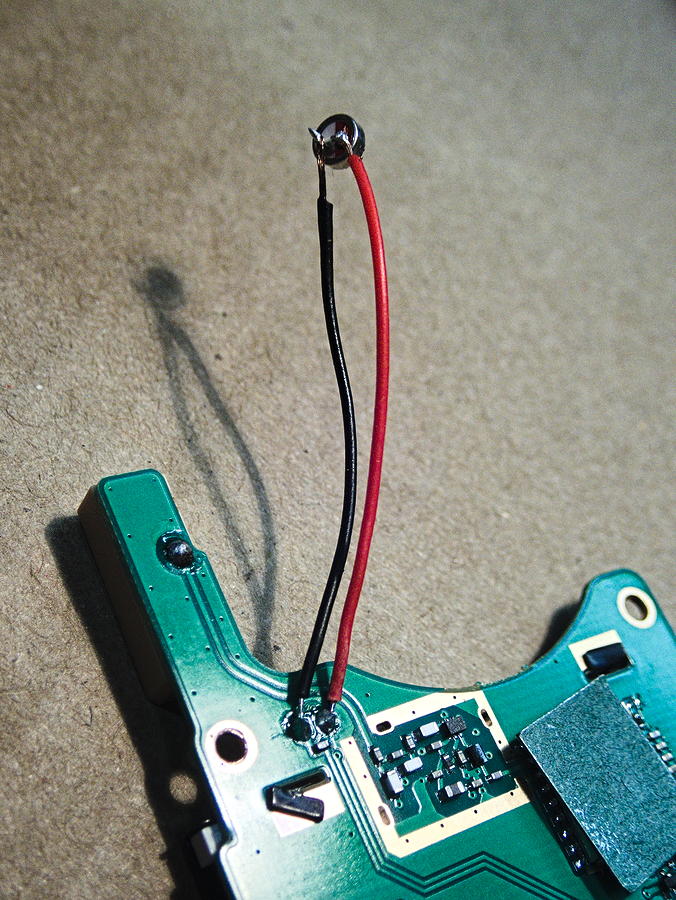
Parallel test: the earbud capsule on two wires, soldered to the mic pads
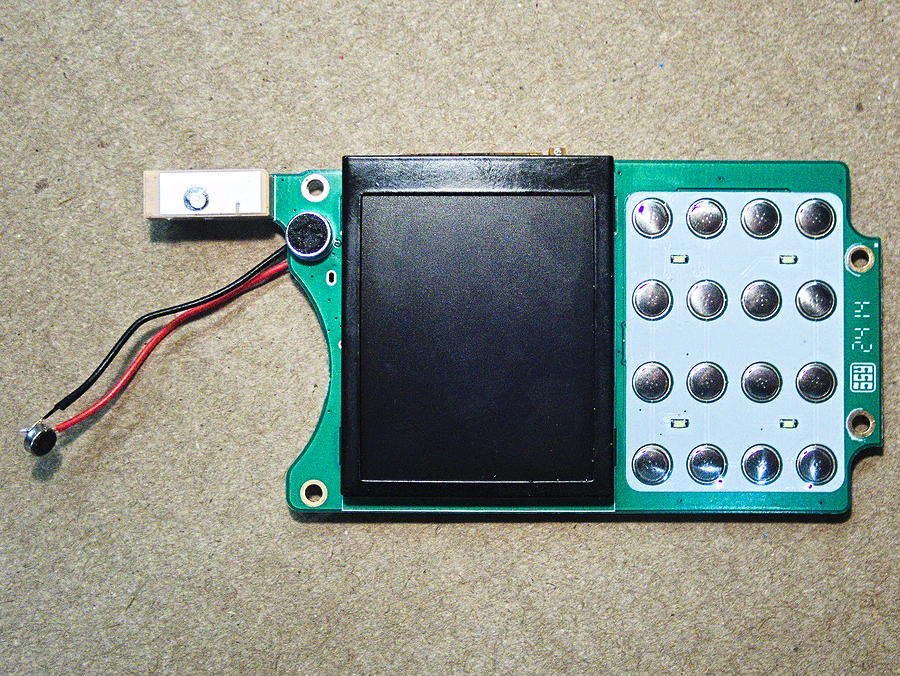
Front side: the original capsule (black) still in place, and the earbud capsule at the end of its wires. It’s noticeably smaller
The new capsule only has flat pads, no legs. I soldered two short bits of copper wire onto it so it could go through the holes in the PCB.
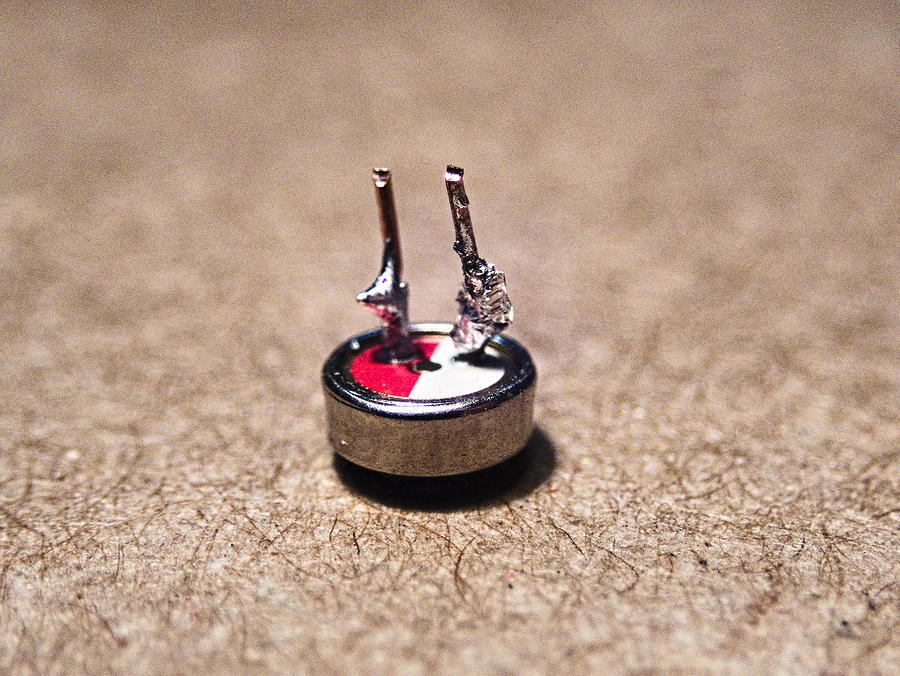
The capsule with its copper wire legs. Not pretty, but it holds
While desoldering the old capsule, I lost C101, a tiny 220 pF SMD capacitor fitted right next to the mic. Its job is to short out the RF that could get back into the mic input when the radio transmits at 10 W. It flew off and I never found it. Or else it disintegrated thanks to my iron’s 450 °C.
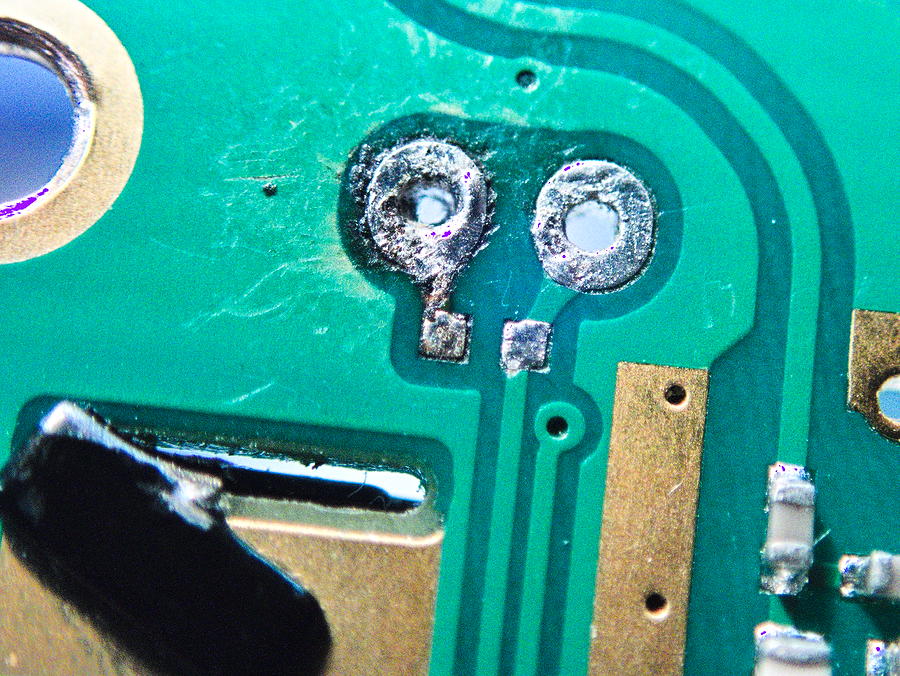
The mic holes after removal, and below them the two empty pads of C101
I didn’t have a 220 pF SMD capacitor at hand, but I had an equivalent ceramic disc. I soldered it straight onto the mic’s legs, on the other side of the board, lying flat next to the speaker. There’s a bit of room, and it only just fits when I close the case. With a tip that’s too big and a bench vice as a third hand, the joints have a bit too much solder and flux, but they hold.
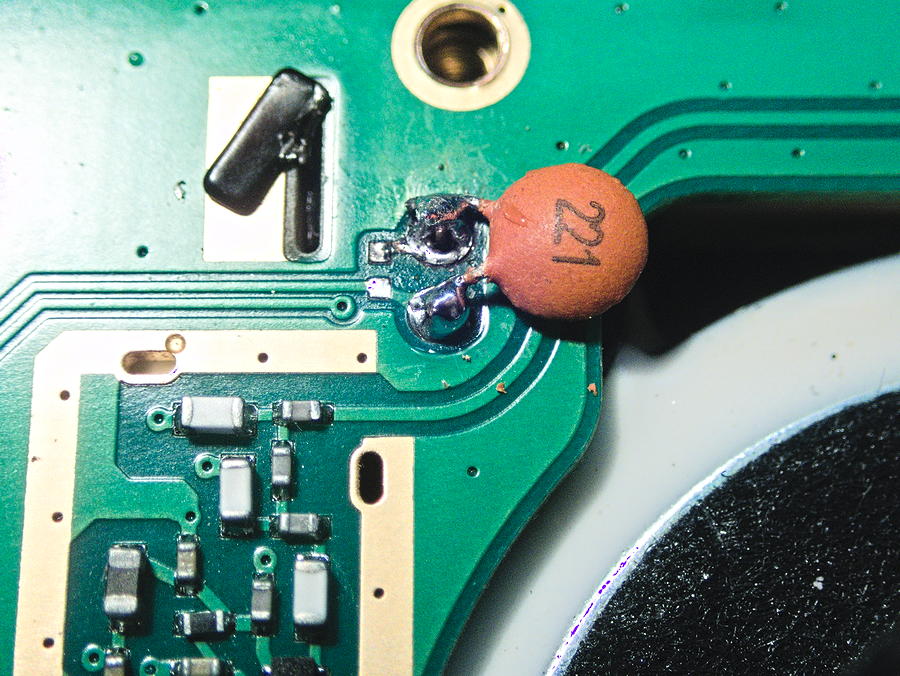
The 220 pF disc capacitor soldered onto the mic’s legs, next to the speaker
The earbud capsule is less sensitive than the original: the VU meter was a bit sluggish. I raised the mic gain to +9 dB, then brought it back down to +6 dB, on FM and DMR (in OpenGD77: Options → Sound → DMR mic / FM mic).
First try on DMR with the Brandmeister parrot through a UHF repeater: the audio coming back sounds a bit weird, but it gets through. On simplex with the Quansheng the audio is good, on UHF too. I test on UHF because it’s the band most affected by replacing the SMD capacitor with a bigger one.
The new capsule is smaller than the old one and no longer fills its seat in the case, so the radio isn’t really waterproof anymore. For now, it’s afraid of the rain (and of my spluttering).
I did a quick repair right before a trip to places where I won’t have parts or tools. I’m keeping the old capsule as a size reference, and in a few weeks I’ll look for a capsule with the same diameter as the original. That will bring back the original waterproofing and sensitivity, and I’ll be able to set the gain back to 0.
By the way, I got to see where the GNSS receive antenna is (the white rectangle in the photo of the PCB’s LCD side). Badly placed, let’s say, but at least I know how to hold the radio if I want a slightly faster fix!